Learning the Labyrinth
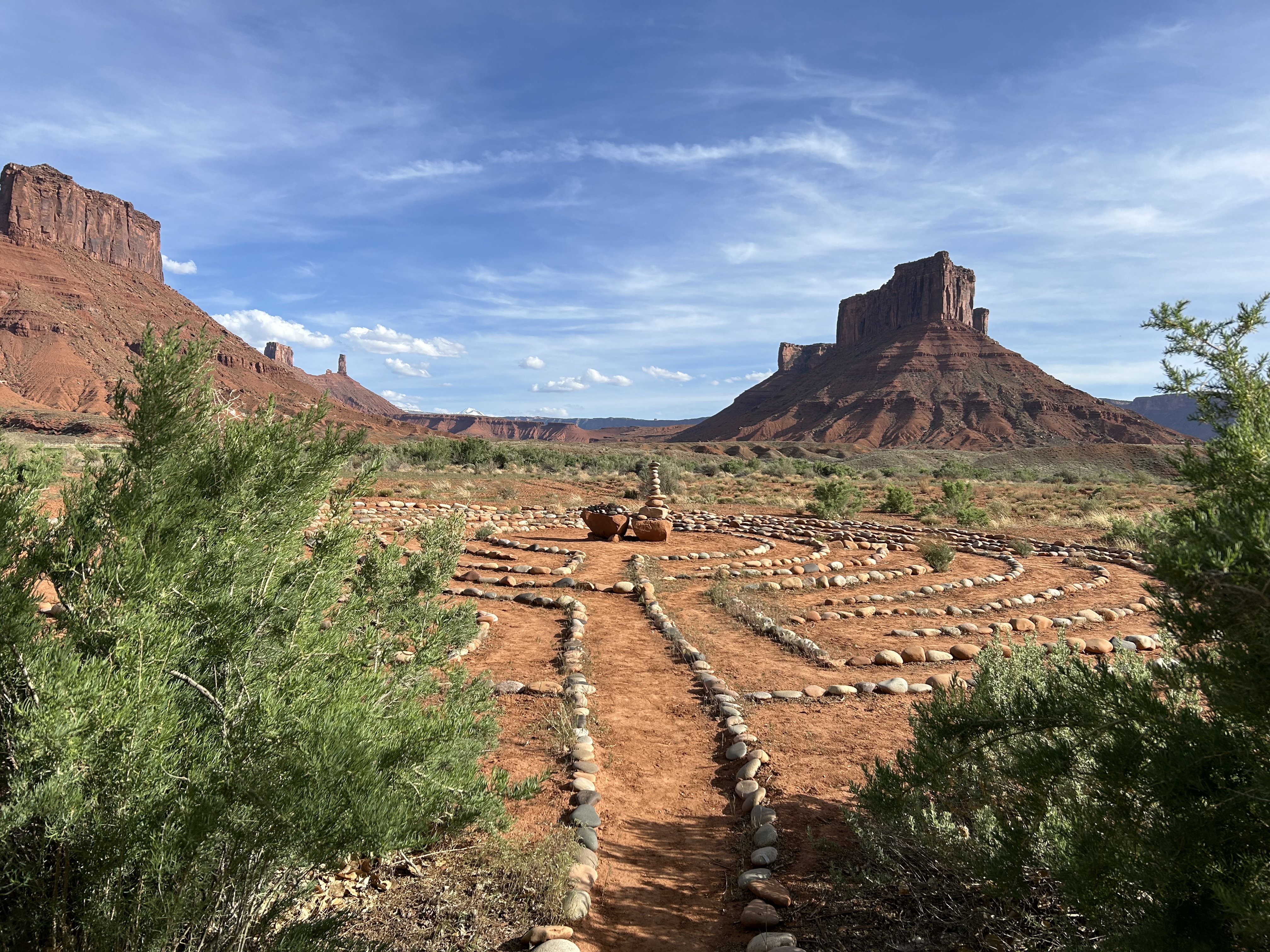
I’ve written about labyrinth’s before; I’m a big fan of the meditative practice of walking the labyrinth and as I just returned from a wonderful spiritually enriching trip that included an unexpected labyrinth I thought I would use this as an opportunity to go a little further in thinking about what these mean in our lives and how we can use the lessons of a labyrinth in our growth. For the next six weeks we are going to walk a metaphorical labyrinth, thinking about what it is, how to approach it, how to walk it, how to deal with frustration, and so on – just like life, because fundamentally teaching us about how to move through our days is what a labyrinth really does.
Just a little history: there is evidence of labyrinth’s dating back four thousand years, they appear first (or oldest) in central Asia and North Africa but they appear on every continent so it may just be that the best preserved are what we think are the oldest. The labyrinth is built into our very body, in the structure of the ear that effects balance and hearing and if I wanted to get real nerdy I would suggest a’la the hermetic tradition that profound connection between the macro example we literally walk and the micro structure that is fundamental to our functioning, as above so below, as outward so inward. We are meant to be mindful of this journey.
Importantly a labyrinth is not a maze. Most modern dictionaries use the words interchangeably probably because modern greek used the word that is translated as labyrinth to describe the maze that contained the minotaur of Crete. But a maze is designed as a puzzle, with wrong turns and dead-ends. A labyrinth is a single path with many turns but no tricks, no traps. You can get lost in a maze, you can not get lost in a true labyrinth – there is one way in and one way out and if you keep to the path you will simply move closer and further from the center, closer and further from the entrance and exit. All you have to do is walk and be present, nothing more is asked of you, and interestingly in all that I have walked you can see the whole thing as you move through it. Nothing is hidden, there are no walls, no unexpected surprises around a corner. It’s all right there with nothing keeping you in but your choice.
I think the first labyrinth I walked was in the desert south of Tucson, right in front of me after I spent an hour searching for it. If I could put one in my front yard I probably would, and invite the neighborhood and passersby to pause and step into the peace of presence for a few moments. Once when traveling with my family we drove past a sign that advertised a garden labyrinth at a nursery on Maui so we flipped the car around and went to explore. It was large, built on the model of Chartes, and I just remember the overwhelming green and flashes of bright hibiscus as I walked. You can roll out a fabric, portable labyrinth which is handy when leading retreats, you can mow it into grass or just place stones. There are several in the regional park near my home and they are always a beautiful surprise when you see the rocks laid out in a valley below you.
The best experiences of the labyrinth for me are always the ones I didn’t expect. It’s a little like going to church on Christmas Eve: you expect to be wowed and amazed and hope to feel something deep but sometimes it just gets lost in the busyness and chaos of the time, it’s more often the ordinary morning when life is quiet enough to hear the bird chirp and really see the flowers and feel the vibration of the music that the spirit can get through. I was in Cincinnati and at the park along the river a labyrinth is tucked in among flowers and shrubs; I’ve thought for years about the child who said “forget this,” half way around, “it’s too much work.” That can often be what life feels like.
Most recently I was riding a bike, going nowhere, just being on a bike pedaling around when I passed a wooden sign that said ‘labyrinth’ with an arrow. So I parked the bike and followed the arrow through a rutted dirt road and then through tall grass and then through a small copse of trees until I came to a clearing and saw the view in the picture. What a gift just to get there, never mind the bonus in the walk itself. I happened to be staying nearby for a few days so I was able to go back a couple more times; I needed the lessons of the walk: the reminders that even when you feel far away from the center if you just keep moving you will get there eventually, that it can feel impossibly long but it’s actually pretty short, that there is a lot to see right where your feet are and that sometimes you need to stop your feet so you can look around.
The lesson, the big lesson is that walking a labyrinth can teach you about how to move through your life and it can do that whether you are spiritual or religious or secular. It’s a kinetic way of learning something that is at the very core of how we function. It’s a nice pause from trying to get somewhere. And it’s really nice to know that you can’t get it wrong.
Discover more from Faith Works
Subscribe to get the latest posts sent to your email.
 Faith Works
once in the Washington cathedral I was walking the carpet labyrinth early in the bigger event I was attending. I walked confidently and mindfully, but something seemed not quite right, but I surrendered that thought and just stepping confidently forward. I entered the center as some point and then moved on. I kept coming back to the center. I tried a little longer then noticed two attendents at the edge, and they waved me over. They said they were waiting for me to finish so they could reassemble the carpet correctly. The carpet pieces were out of order. I was amused and grateful for their patience. It was a very interesting experience. I have walked many labyrinths before and since that experience.